Event
Descriptions
Floor
exercise
 The
entire floor area should be used during the exercise, which consists
primarily of The
entire floor area should be used during the exercise, which consists
primarily of
tumbling passes performed in different directions.
Acrobatic elements forward and
backward and acrobatic elements
sideward or backward take-off with one-half-turn
must be performed
during the routine. There must also be a non-acrobatic element
included, such as a balance element on one leg or one arm; a static
strength move,
held for two seconds; or jumps, circles or flairs.
Transitional skills, or gymnastics
movements performed in between
tumbling and acrobatic passes,
should be executed with proper rhythm
and harmony.
The exercise must not exceed 70 seconds in length.
Today’s
floor exercise routines consist of dynamic tumbling skills that only
a few years
ago were performed solely on the trampoline. The best
gymnasts will incorporate
tumbling passes with substantial
difficulty, performing multiple twisting and flipping
saltos during
their routines on the 40’ x 40’ floor exercise mat.
This
event is difficult because:
It is one of the more difficult
events to achieve a high difficulty value.
The best routines will
include difficult tumbling passes with connected
bounding skills and
will look near-effortless to the spectators.
What
can we expect to see?
-
Difficult
tumbling passes with multiple flips and twists
-
Connected
bounding skills
-
Creative
routines with a high difficulty value which have no
-
execution
errors and stuck landings
Pommel
horse
 Many
consider the pommel horse to be one of the most difficult of the Many
consider the pommel horse to be one of the most difficult of the
men’s gymnastics events. It requires an enormous amount of
practice to
master even the most basic skills.
Pommel
horse routines consist of continuous circular movements interrupted
only by the required scissors elements. Swinging through a handstand
position,
with or without turns, is allowed. The hands are the only
part of the body that
should touch the apparatus and the entire
exercise should flow with steady,
controlled rhythm. A maximum of
two cross support travels for bonus are
permitted (forward and/or
backward). The hand placements should be quick,
quiet and rhythmic.
This
event is difficult because:
The event’s difficulty stems
from two factors. First, the gymnast must perform
skills with a
circular movement in a horizontal plane. Second, he spends most
of
each routine on only one arm, as the free hand reaches for another
pommel
or part of the horse to begin the next skill.
Pommel
horse is the only event in which gymnasts do not get to stop or
pause
during the routine. If a gymnast gets in trouble, he must
continue moving through
the routine while making corrections. The
constant movement makes this very
difficult to do. Also, many of the
skills learned in gymnastics can easily be transferred
to other
events; however, with the exception of a circle and a flair circle,
this is not
the case on pommel horse.
Mastering basic skills on this
apparatus often takes twice the time.
While
the untrained eye may not catch these flaws, judges may deduct for
several mistakes. For example, deductions may be taken if the hips
are not high
enough and the legs are not separated enough while
performing the scissors
requirement; the gymnast does not make it
completely up to a handstand
during a handstand dismount; or the
gymnast performs a dismount that
does not match the rest of the
routine.
What
can we expect to see?
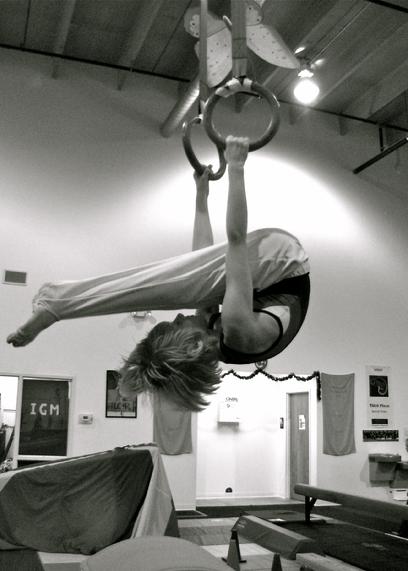
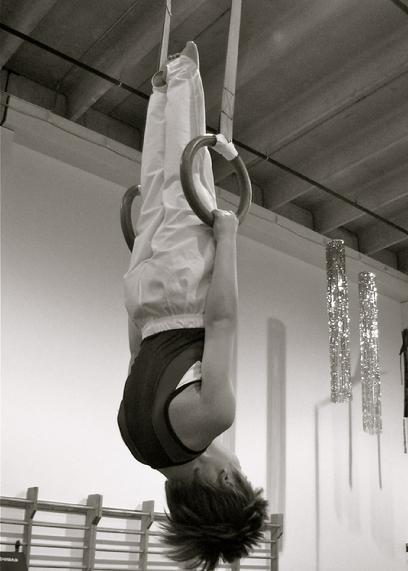
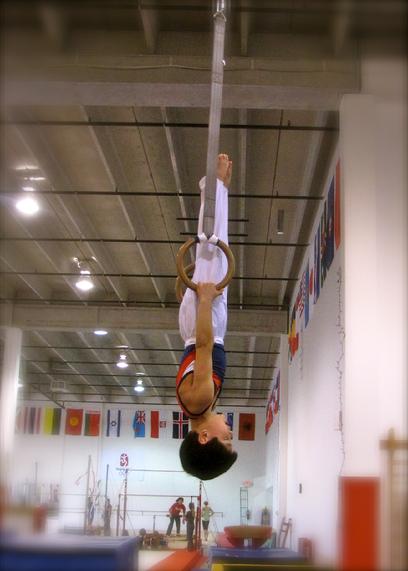
Still
rings
 Stillness
and proper body position while performing strength elements Stillness
and proper body position while performing strength elements
are
paramount on the still rings. Gymnasts with the best command of the
event will display extraordinary skill in arriving at all holds with
absolute
precision. The rings should be absolutely still and under
control at the end
of each skill. The body should be straight with
no arching, and arms should
be sturdy and strong with no shaking.
The
still rings routine must include o ne swing to handstand and swings
to strength hold elements. At least two elements of strength, one
swing
to strength element and the other a static strength element,
must be held
for two seconds during the routine.
Examples
of strength elements include a cross, an inverted cross and a
swallow
or Maltese cross. A cross is performed in a straight body or
L position with the
body perpendicular to the floor and arms
stretched perpendicular to the body,
while an inverted cross is
executed in an inverted handstand position with arms
stretched
perpendicular to the body. A swallow or Maltese cross is performed
when the body is in a straight position parallel to the floor at
rings height.
The rings must remain still throughout the routine.
Deductions are taken for unnecessary
swings and instability.
Today,
the trend among gymnasts is to achieve a high difficulty value for
their routine
by combining strength moves with one another.
Look
for confidence in the strength elements. The gymnast should move
directly into
the proper and controlled position when performing his
cross or Maltese, stopping
securely for a full two seconds, and then
move smoothly into the next part.
During the swinging elements,
watch for stretched body positions and straight
handstands.
This
event is difficult because:
It requires a great deal of upper
body strength and it is almost impossible to
obtain a high start
value without strength moves in the routine. Gymnasts
without
excellent upper-body strength fail to score high on this event. If a
gymnast does have a high difficulty value, it often boils down to
sticking the
dismount in order to win.
What
can we expect to see?
-
Strength
moves connected to strength moves that are held in a perfectly
-
straight position for more than two seconds
-
Straight
handstand positions
-
No
movement of the feet during the landings (stuck dismounts)
Vault
 Quick,
explosive and dramatic — a good vault is often described as a
“big” vault. Quick,
explosive and dramatic — a good vault is often described as a
“big” vault.
The height, distance of travel, overall
acceleration into the vault and sudden
impact of a no-step, “stuck”
landing all create a good impression for the judges.
Men
have a choice of performing one or two vaults, depending if a
gymnast is
attempting to qualify into the individual event finals of
this event. Each individual
vault has been assigned its own value
based on the vault’s complexity.
Following
the pre-flight from the springboard to the table, the gymnast must
demonstrate a rise in the height of his body after pushing off of
the table and not
deviate from the extended axis of the table. The
gymnast should show an opening in preparation for a controlled
landing, which should be accomplished without extra steps and in
line with the table, springboard and runway.
This
event is difficult because:
The entire performance happens
very quickly. The gymnast must stay intensely
focused and be
prepared for the ground when it is time to land. Speed, power
and
spatial awareness are essential to performing high-level vaults
correctly.
What
can we expect to see?
-
Handspring
double fronts in the piked position and in the tucked position with
a half-turn
-
-
Tsukahara
double backs in a tuck and piked position
-
Kasamatsu
stretched with multiple twists.
-
Yurchenkos
(round off entry vaults) with multiple twists
Parallel
bars
 A
parallel bar routine consists mostly of swing and flight elements.
The gymnast should not stop or hold a move more than three times
during the routine. The gymnast is required to execute swinging
elements from a support, hang and upper arm position. The gymnast is
also required to perform an under swing, sometimes referred to as a
basket swing. A
parallel bar routine consists mostly of swing and flight elements.
The gymnast should not stop or hold a move more than three times
during the routine. The gymnast is required to execute swinging
elements from a support, hang and upper arm position. The gymnast is
also required to perform an under swing, sometimes referred to as a
basket swing.
The
most difficult skills require the gymnast to lose sight of the bars
for a moment, such as a double front or back salto. Difficulty is
earned by executing these skills in connection with other higher
valued skills.
This
event is difficult because:
It requires a great deal of
hand-eye coordination, timing and balance. Many of the skills’
execution must be coordinated with the flex of the bars. Losing
sight of the bars on the high-level skills makes it difficult to
re-grasp the bars and smoothly continue.
What
can we expect to see?
-
Double
front and back saltos in-between the bars performed in tuck and
piked positions
-
Peach
basket elements from handstand to handstand often with half and
full turns
-
Double
backward dismounts in a piked position with stuck landings
Horizontal
(high) bar
 Usually
the most crowd-pleasing and spectacular of all the events, the
horizontal bar consists of swings, release moves and high-flying
dismounts. Usually
the most crowd-pleasing and spectacular of all the events, the
horizontal bar consists of swings, release moves and high-flying
dismounts.
During
the routine, the gymnast must execute a series of continuous swings
and turns and at least one move in which the gymnast releases and
re-grasps the bar. He also must perform at least one element in
el-grip, dorsal hang or rearways to the bar.
The
gymnast is also required to perform an in-bar skill, such as a
stalder circle. High-level gymnasts usually complete multiple
release moves and receive bonus points for connecting
high-difficulty skills before and after their release moves. Look
for soaring dismounts with multiple somersaults and twists.
This
event is difficult because:
A gymnast must perform very
difficult release moves that have a small margin of error to have
any hopes of winning. Release moves are performed 12-15 feet over
the bar, which requires a fearless and aggressive effort. He must
maintain form throughout the release move and while catching the
bar, which is usually a matter of just inches. The world’s best
will have several release moves, no execution errors and a big
dismount with a perfect, stuck landing. Examples of big release
moves are Kovacs with a full twist, a Tkatchev stretched with a full
twist or a Gienger with a full twist.
What
can we expect to see?
-
Double
back saltos over the bar (Kovacs) in different body positions
-
(tucked, piked and stretched) performed with twist.
-
Double
twisting, double back dismounts in a stretched position
-
Intricate
in-bar skills with pirouettes
Olympic
competition order
The international competition order is
decided by the FIG.
The men’s Olympic order is floor exercise,
pommel horse, still rings, vault,
parallel bars and horizontal bar.
|